
The Score of Resilience: Elio Piedra’s Journey Toward Professional Growth
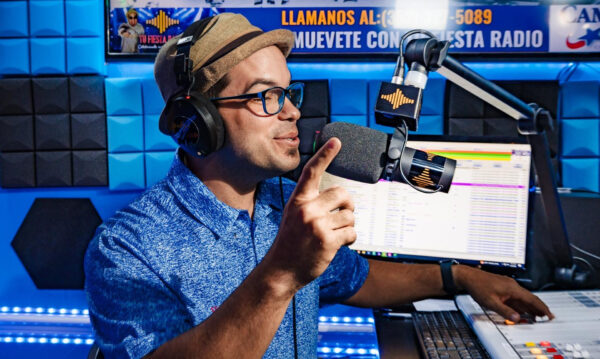
Elio’s story is a reminder that professional growth is never a straight line. It is something built day by day, through focus and discipline. We sat down with him to talk about his beginnings, and took a stroll down the memory lane. With smiles and quiet nostalgia, he took us on a journey to his humble roots in Cuba , subsequently leading to his life in the United States, a life defined by the ability to adapt without ever losing sight of who he is.
Today, Elio stands as living proof that with dedication and a clear sense of purpose, anyone can accomplish their goals. He arrived carrying a plastic bag as his only possession, but with his diligence, tenacity and perseverance, he has come a long way and now leads meaningful projects that shape his community.
Elio, tell me about the early years of your life in Cuba.
I had an amazing childhood. We didn’t have much, but life was beautiful. As a boy, my passion was soccer and everyone assumed that was my future, because I seemed to have real talent for it. Buy when I was seven, a group of teachers came to our school to run musical aptitude tests, and one of them noticed I had a natural sense of rhythm.
My mother, who worked as a receptionist at the school, signed me up and the teacher was thrilled. In the end, I chose music, because in Cuba it carries enormous cultural weight. By the time I was nine, I was enrolled at the Vocational School of Arts, a boarding school where I lived until I was fifteen. I spent four years at the conservatory. That experience forced me to grow up quickly and learn to stand on my own from a very young age.
The conservatories in Cuba have an extremely rigorous and intense program. How did that shape your growth? What did you take away from it, and how did your professional life begin?
It was a school for life in every sense. I trained in classical music, lyrical singing, and music theory, though we also explored theater and dance. My foundation is classical. I studied Bach extensively, and some of my most beautiful memories are of performing with the conservatory’s symphony orchestra.
By sixteen, I was already playing with professional orchestras. We won the Premio Joyas in Cuba, which opened doors to television and gave me the opportunity to record alongside artists like Bobby Carcassé. I worked in cabarets as a timbalero and accompanied singers like Marielena Lasso, all of this before I turned eighteen, when mandatory military service came knocking.
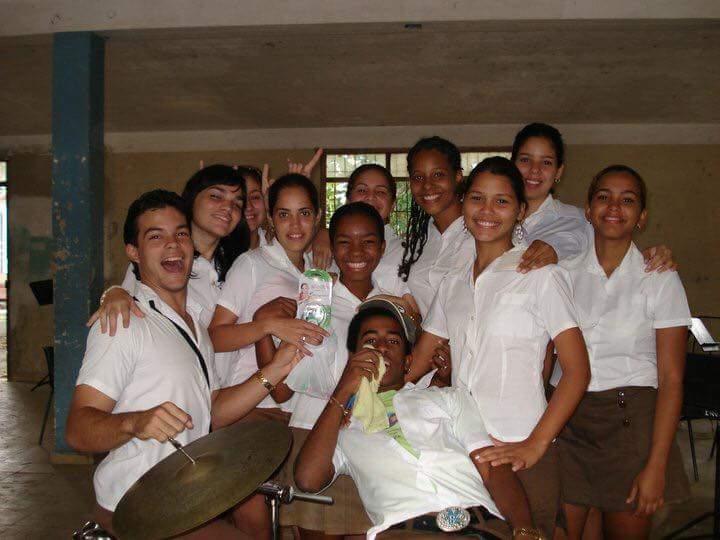
Elio with classmates at the conservatory at 15 years old
And with all those experiences, were you already making plans for the future?
Honestly, I planned to move to the capital and continue with higher studies in music. After graduating, I kept preparing for recordings and performances, and I continued playing with different orchestras. Eventually I joined a salsa orchestra.
That was actually where I first discovered Willy Chirino’s music. The orchestra was from his hometown in Cuba, Consolación del Sur. For me, the whole experience was incredible — I was so young!
Then everything changed In Cuba, when you turn 18, you are drafted into military service. I was no exception.
I remember my mother calling me one afternoon and saying, “Elio, they just left you a letter from the military committee.” I asked her, “When do I have to leave?” And she said, “In six weeks.”
Imagine that. I can’t explain what that feels like. It is as if the world suddenly falls apart beneath your feet.
How did the transition from the stage to military service, and later to life in the United States, shape your journey?
It was incredibly difficult.
I spent the first 45 days in a military unit, followed by months of manual labor in the fields. Eventually, someone discovered that I was a musician, and I was transferred to the Armed Forces’ artistic ensemble. We put together a full production and toured throughout the country.
I completed my military service in August, and by November 2011, I had arrived in the United States.
The culture shock was overwhelming. In Cuba at that time, there was no widespread internet access, no social media, and no smartphones. People simply didn’t have the kind of connectivity that existed elsewhere.
I came to the United States because of my wife. We met in school when we were just eleven years old and became childhood sweethearts. We were together until we were thirteen, when her mother petitioned for her to leave Cuba. Even after she left, we stayed in touch. Six years later, she returned to Cuba and asked me to come to the United States with her.
To be honest, moving to the United States was never part of my plan. But sometimes love opens a door you never expected.
Leaving was especially painful because, although I had left home at a young age for my studies and military service, I had never left the country, and I had certainly never been separated from my parents. The hardest part was leaving my father. We had always been extremely close.
I arrived with almost nothing—a plastic bag and the clothes I was wearing. I didn’t speak a word of English.
My in-laws picked me up at the airport and took me out for pizza. I remember looking at the size of it and thinking, What is this? I had never seen anything like it.
But beneath that moment of surprise was something much heavier. The reality of leaving my family behind finally hit me. A knot formed in my throat, and I couldn’t eat a single bite.
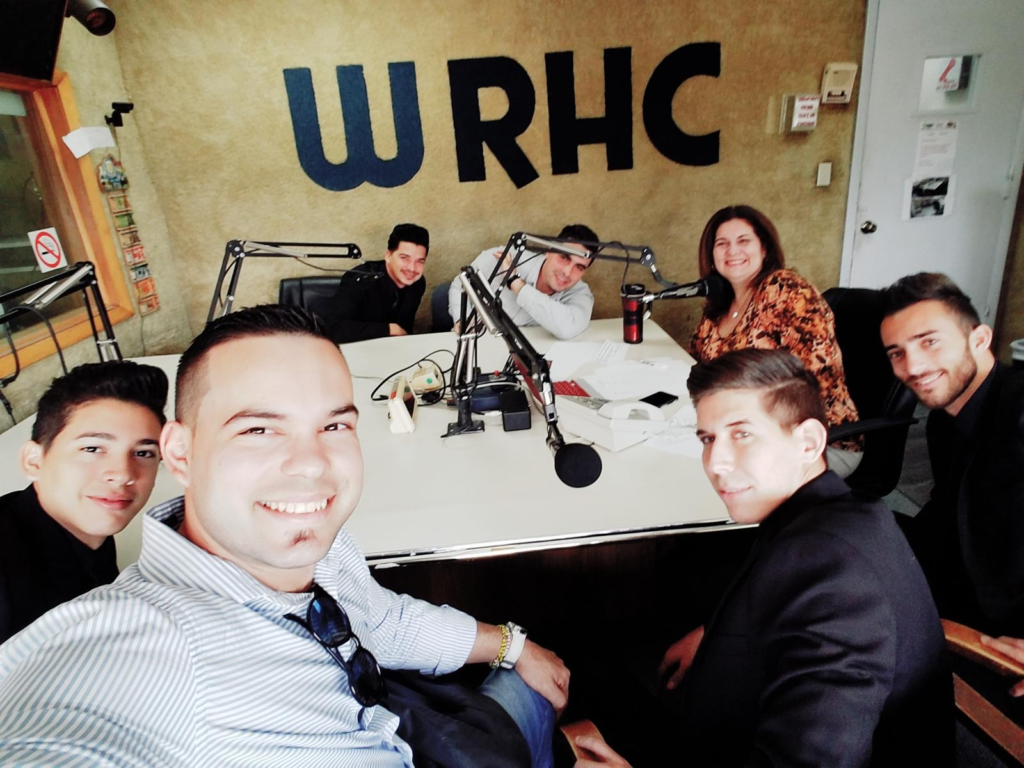
Touring the US with the media production company
It’s not about where you start, but about where you direct your focus. Elio understood that from day one.
Shortly after arriving, Elio found work at a local restaurant called Saboré. “They hired me to wash dishes, and I did it without a second thought,” he tells me. From there, he worked his way into the kitchen, learning from chefs Willy, Alexis Rosario, and Valero, applying the same discipline he had built in the conservatory.
For Elio, that period laid the foundation for everything that followed. His guiding principles became clear: “Only consume things that add to you. Surround yourself with the right people, and keep your distance from those who aren’t.” His philosophy is straightforward: your environment and your mindset set the ceiling on how far you can grow.
But the kitchen was never the destination, just another stop along the way. His years working as a musician and tour manager took him across stages and cities, and it was in that world, in the rhythm of constant movement, media exposure, and storytelling, that something crystallized: his calling wasn’t only the stage. It was everything surrounding it. Communication and Media. When the pull of family and the desire to be present for his daughters in Gainesville grew stronger than any road ahead, the choice made itself. He put down his roots and built his own radio station.
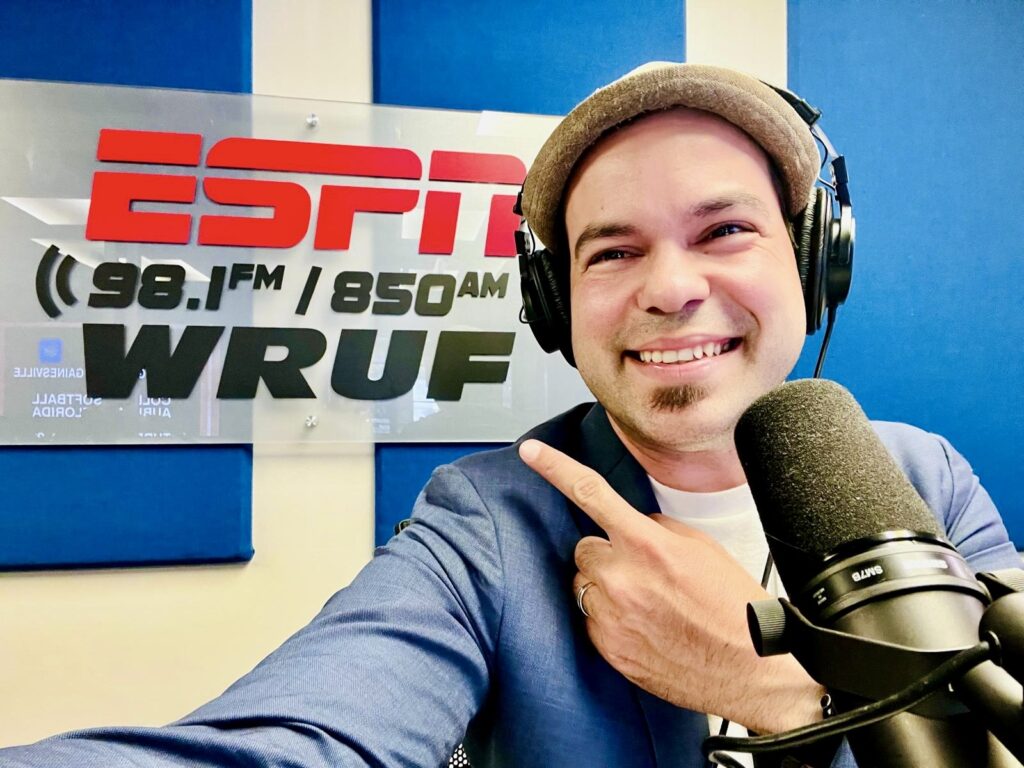
FIFA 2026 at ESPN WRUF
After the kitchen, how did you reclaim your musical career and grow so much from there?
I never lost focus, even while I was cooking. I saved up and bought my own drum kit so I could keep practicing. I started teaching music at Guitar Center and eventually had thirty-five students. Then life led me to Arts Management Associates, where I toured twenty-five states as a drummer and tour manager. That chapter gave me an amazing exposure in radio and national television. But I knew I wanted to be present for my family and my daughters, so between 2015 and 2016, I turned my energy toward the local community, creating entertainment spaces and radio projects to strengthen our Latino roots right here.
What would your advice be to someone who feels the road is just too hard?
I’d tell them to get crystal clear on what they want and then give it everything they have. Find a mentor, someone who believes in you and can help guide the way. Be intentional about who you let into your circle. The people around you either lift you or hold you back, and knowing the difference is what separates stagnation from progress. We’re all capable. But you have to be willing to protect your energy and hold onto your gratitude.
And finally, if you could stand in front of that young man who arrived with just a plastic bag, what would you say to him?
I’d look him in the eyes and say: I am so proud of you. Keep going, because it’s not over until we win.
Elio Piedra arrived with nothing but built a life worth everything. It was not overnight and there were no shortcuts involved. There were several setbacks but he remained steadfast to his beliefs that he never let go of, that every chapter teaches you something, and that the people and places you choose shape how far you can go. His is not a story of exception. His story is proof that the right mindset is pivotal, that commitment to strive for success can elevate the course of your life.